


Alerts
An Alert is a notification from Navigate designed to raise awareness that a student is not meeting expectations in some way. Alerts can be raised by instructors for many academic reasons. Alerts should be raised after a faculty member has attempted to reach out to their student(s) AND are requesting additional support(s). If your communication attempt (for example: phone call, email, meeting with a student before or after class) is unsuccessful, then an Alert should be raised so that an additional outreach attempt can be made by the student’s assigned Advisor(s). When an Alert is raised, after an unsuccessful attempt of resolving the issue or concern by a faculty member, Advisors treat Alerts as an acknowledgment that additional outreach and/or support is needed. To learn more about Alerts in Navigate, please read the Alerts and Case Management Workflow below.
Alerts & Case Management Workflow
| Alert | Definition | Alert Type | Alert Location | Care Unit Assigned | Should Student Receive Email Notification | Who Receives a Faculty Email Notification | Does Alert Automatically Open a Case | Does Alert Automatically Get Assigned to advisor(s) |
| 3+ Attendance Absences | Raise this Alert when a student isn't attending class regularly. | Negative | Issue an Ad Hoc Alert/Progress Report | No | Yes | N/A | No | No |
| Attendance - Never Attended Class | Raise this Alert to indicate that a student has never attended your class. | Negative | Issue an Ad Hoc Alert/Progress Report | No | Yes | N/A | No | No |
| Class Engagement Concern | Raise this Alert when a student is demonstrating a lack of engagement. | Negative | Issue an Ad Hoc Alert/Progress Report | No | Yes | N/A | No | No |
| In Danger of Failing | Raise this Alert when a student is in danger of failing a course. | Negative | Issue an Ad Hoc Alert/Progress Report | No | Yes | N/A | No | No |
| Kudos - Great Effort / Showing Improvement | Raise this kudo when a student has shown improvement in a course. | Positive | Issue an Ad Hoc Alert/Progress Report | No | Yes | N/A | No | No |
| Missing/Late 2+ Assignments | Raise this Alert when a student is missing or late with two or more assignments. | Negative | Issue an Ad Hoc Alert/Progress Report | No | Yes | N/A | No | No |
| Referral - Tutoring Services | Raise this referral to refer students to the Academic Center for Excellence for Tutoring. | Neutral | Issue an Ad Hoc Alert/Progress Report | No | Yes | N/A | No | No |
| Meet with Your Academic Advisor | Raise this Alert when a student needs to meet with their advisor. State the reason(s) why student needs to meet with their advisor in the comment field. | Negative | Issue an Ad Hoc Alert/Progress Report | No | Yes | Student's Assigned Advisor(s) | Yes (New, opens a case for Academic Advisor to close) | Yes |
| Recommend Pass/Fall or Withdrawal | Raise this Alert when a student may benefit from taking a course pass-fail or withdrawing from a course. | Negative | Issue an Ad Hoc Alert/Progress Report | No | Yes | Student's Assigned Advisor(s) | Yes (opens a case for Academic Advisor to close) | Yes |
Important Message About Raising Alerts
The following two Alerts in Navigate will automatically open a Case. A Case is an Alert or Referral that is assigned to the student’s advisor(s), or in some instances, a campus official for further action. Moreover, a Case is an electronic case file where staff across departments (e.g., financial aid, bursar, tutoring, counseling) can coordinate and collaborate on the follow up with the student. Cases create a formalized next step for action or intervention on the issued Alert or Referral, should that be needed. The electronic record logs all attempted outreach (failed/successful), and Case Outcomes. Details about the Case, including the Case Outcome (Case Closure Reason), can be found on the History tab of a Student's Profile page.
- Recommend Pass/Fall or Withdrawal - Because this Alert signals a potential academic impact, an advisor (faculty or professional) must meet with the student to discuss academic and financial implications and will close the case upon completion.
- Meet with Your Academic Advisor - To maintain opportunities for proactive outreach, we will introduce a new Alert type encouraging students to connect with their advisor.
- Staff raising this Alert are encouraged to include specific context in the Comments field to guide the academic advisor’s conversation.
- The academic advisor is responsible for closing the Case, but if they lack specific context, they won't know the problem(s) they are supposed to solve, slowing down the outreach process and making the system less proactive.
- An example when you may want to raise the Meet with Your Academic Advisor Case Alert might be initiated if a staff member has general concerns that either they can't specifically identify (intuition) or that they feel they might not have the experience or resources to provide the kind of assistance the student might need. Please state the reason(s) why student needs to meet with their advisor in the comment field.
A Note About Writing Comments About Your Students
Progress Report
When an Alert is raised through a Progress Report and an instructor provides comments, students can review those comments in either of the following two ways:
- Select the MY Docs icon in their Navigate account.
- Review the alert reason notification email that is sent to their Buffalo State University Outlook account.
Ad-hoc Alerts
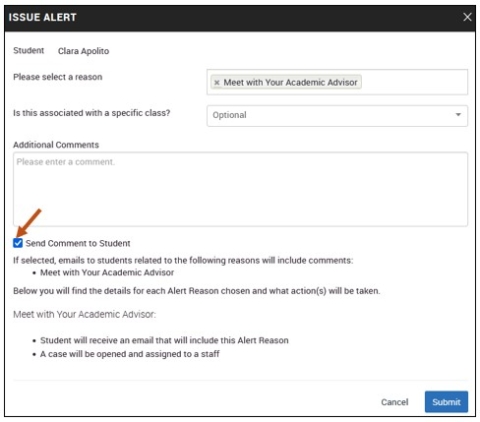
Students can now also view comments written about them when an Alert is raised ad-hoc. The staff member must select the following option: Send Comment to Student when raising the Alert. The comment will be included in the alert reason notification email that is sent to students Buffalo State University Outlook account.
-
Alerts raised for students who are Freshmen and Sophomore should be managed by the student’s assigned Professional Advisor.
To learn more about Cases, please read the Cases document.
Case Outcomes or Case Closure Reasons
Academic Advisors will provide Case Outcomes or Case Closure Reasons and comments only after outreach to the student is attempted. This might include a phone call, email or text message explaining the issue, the potential impact, resources available, and solicitation to connect with their faculty member, or Academic Advisor(s).
Case Outcomes or Case Closure Reasons:
- Discussed concern with student.
- Student contacted multiple times with no response.
- Student connected with appropriate resource.
- Student declined assistance.
- Student has or plans to withdraw from course.
- End of Term. No resolution.
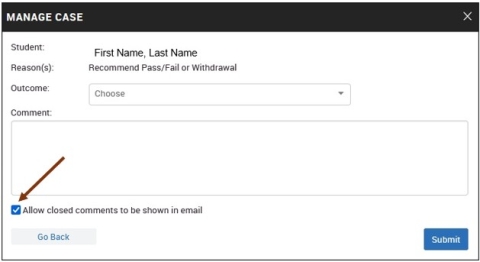
When selecting an Outcome or Case Closure Reason and leaving comments, it is recommended that you place a check mark next to the box: Allow closed comments to be shown in email. These comments are included in the Case Closed email that is sent to the faculty member who raised the initial Alert. As the instructor who raised the Alert, if you need to discuss the Case further, please reach out to the advisor(s) who closed the case.
A Closed Case does not necessarily mean that a student was successfully contacted. For instance, there are times that despite our multiple attempts, a student will not respond to our outreach or intervention. In these instances, the Case should be closed with the following Case Closure Reason: Student contacted multiple times with no response.
Additional Resources & Training Materials
- To learn more about Alerts, please read the Alerts document.
- To learn how to raise an Ad Hoc Alert in Navigate, please read the Alerts document.
- To learn how to raise an Alert via a Progress Report in Navigate, please watch the How to Complete a Progress Report video. Access requires your BSU Username and Network password.
- To learn how to raise an Alert via a Progress Report in Navigate, you may also read the How to Complete a Progress Report training guide.